5 Lessons: How to Choose Products to Create (for Technical Founders)
Every technical founder has at least one unfinished side project. It usually starts with a great idea, a burst of motivation, and a few late nights of coding. Weeks later, there's a working prototype, a polished codebase, and maybe even a deployed application—but no real users and no paying customers. More often than not, the problem isn't the quality of the code. It's that the product was built before anyone proved the problem was worth solving.

This article is based on the “5 Lessons: How to Choose Products to Create (for Technical Founders)” talk presented by Jerguš Frajt at CODECON #Bratislava 2026. Drawing from real product development experience, it explores a practical framework for validating ideas before writing production code, prioritizing what truly matters, and increasing the chances of building products that people are actually willing to pay for.
Find the gap
For developers, building is the fun part. We enjoy solving technical challenges, experimenting with new frameworks, and turning ideas into working software. It’s hard to resist the temptation to open your IDE and start coding.
But that’s exactly where many technical founders go wrong.
A well-built application doesn’t automatically become a successful product. If it solves a problem that nobody actually cares about—or one they’re not willing to pay to solve—even the best architecture won’t save it. Before writing production code, the real challenge is understanding whether the problem is worth solving in the first place.
One of the key ideas from Jerguš Frajt’s framework is simple: don’t look for interesting ideas—look for painful problems. Products that succeed usually originate in one of two places. Either they solve a problem you’ve experienced yourself, or they’re built alongside someone who understands the domain inside out and has direct access to the people facing that problem every day.
The second approach is often the stronger one. A domain expert brings something developers usually don’t have: deep industry knowledge, access to potential customers, and continuous feedback. Instead of guessing what users need, you’re learning directly from the people who will eventually decide whether your product is worth paying for.
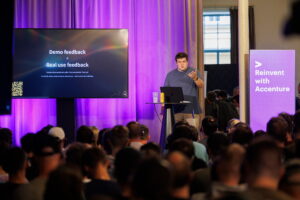
Validate with Demo + Feedback Loop
One of the biggest mistakes technical founders make is investing too much time in building before talking to users. The longer you wait for feedback, the more expensive every change becomes.
Instead of building a production-ready application, start with the simplest possible demo. Today’s AI prototyping tools make it possible in hours, not weeks. At this stage, the goal isn’t clean architecture—it’s learning whether people actually want what you’re building.
Just as importantly, don’t focus only on what users say. Pay attention to the questions they ask. When someone starts asking “Can it also do this?” or “What happens if I…?”, they’re no longer reviewing your idea—they’re already imagining themselves using the product. That’s often a much stronger validation signal than a polite “Looks great.”
Stay in this rapid feedback loop for as long as possible. Iterating on a prototype is cheap. Iterating on production code rarely is.
Product Economics
A technically impressive product isn’t necessarily a viable business. Before investing weeks or months into development, ask a much simpler question: would someone actually pay for it?
During early conversations with potential customers, focus on understanding the business value. How much time does your solution save? Does it reduce costs? Can it help generate more revenue? Most importantly, ask what they’d realistically be willing to pay. These conversations often teach you more than building another feature ever could.
Jerguš also recommends thinking about product economics early. A product with a small market or limited revenue potential can still be a great side project—but it may never become a sustainable business. Knowing that before you start building helps you invest your time where it has the biggest chance to pay off.
Build the MVP
Once you’ve validated the problem and confirmed there’s business potential, it’s finally time to write production code. But that doesn’t mean building every feature you’ve imagined.
Prioritize features based on two simple questions: How much value will this bring to users? and How much effort will it take to build? Features with high impact and low effort should always come first. Everything else can wait until users prove they actually need it.
A common mistake is spending weeks polishing dashboards, analytics, mobile apps, or advanced integrations before customers have even adopted the core product. Your first version only needs to solve the main problem well enough that someone is willing to pay for it. Everything else belongs on the roadmap.
Launch with First Customers
Don’t launch to the world. Launch to a small group of real users first. They should be willing to pay and, just as importantly, willing to give honest feedback. That’s where you’ll learn what works, what doesn’t, and what your product really needs next.
Your first customers shouldn’t feel like anonymous users. Talk to them regularly, understand what’s blocking their workflow, and fix the issues that prevent them from getting value from your product. Not every feature request deserves immediate attention, but recurring problems almost always do.
The goal isn’t to build the perfect product. It’s to build a product that solves a real problem well enough that people keep coming back—and keep paying for it.
Bonus: Production Always Finds the Bugs You Didn’t
Even after validating your idea, production has a way of surprising you. Small configuration mistakes, broken deployment pipelines, or environment-specific issues can easily turn a successful launch into a frustrating experience.
That’s why pre-launch testing shouldn’t stop at unit or integration tests. Verify your production environment, test critical user flows end-to-end, and never assume that “it works on localhost” means it’s ready for customers.
Want to Learn More?
Watch Jerguš Frajt’s full talk from CODECON for more real-world examples, practical insights, and actionable advice on validating product ideas, building the right MVP, and launching products with paying customers.

“An app in a Git repository that nobody pays for is not a product. It is a hobby.”
FAQ
How do you know if a product idea is worth pursuing?
Validate the problem before building the solution. Talk to potential users, understand their pain points, and find out whether they’d actually pay for a better way to solve them.
Why should you validate with a demo instead of building an MVP?
A demo lets you gather feedback quickly and cheaply. Making changes to a prototype is much easier than reworking production code after you’ve already invested significant time in development.
What’s the biggest mistake technical founders make?
Starting with code instead of validation. Successful products begin with understanding the problem, validating demand, and only then building the solution.
Have a question for the speaker?
Connect with Jerguš Frajt on LinkedIn and continue the conversation after the talk.